Skip to content
Why custom product pages

Same app. Different reasons to download.

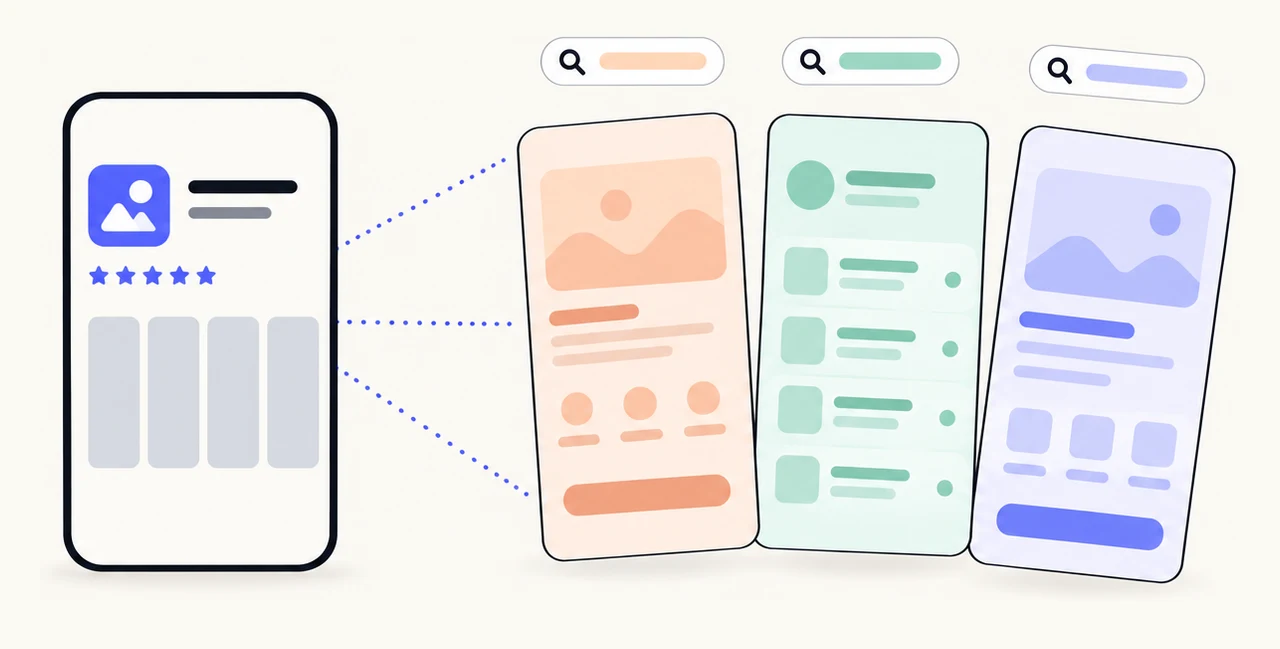
Your App Store page shows everyone the same screenshots, whatever they searched for. A custom product page is another version of that page, made for one search. Pagefully plans them and builds each one from your own screenshots.

What it is

One app. A page for each search.

Lull is a sleep sounds app. Its default page leads with its catalogue. The custom page below is the same listing, same name and reviews, shown to people who searched for white noise for a baby.

Default pageWhat everyone sees today

Whatever they searched for.

Custom product pageFor people searching “white noise for babies”

The same screenshots, with headlines about the thing they came for.

  • 70custom product pages per app, Apple’s limit. Most apps use none.
  • 1default page, which stays exactly as it is. A custom page is added beside it.
  • 0new builds. Pages are made in App Store Connect, from screenshots you already have.
Why it matters

The first look decides the download.

People decide in seconds, from the first screenshot. A page that leads with the reason they came gives them that decision at once.

People see what they came for

Someone who searched “white noise for babies” sees the baby sounds first, not a general story about sleep. The page answers the search.

More downloads from the same people

A page that answers the search turns more of the same visitors into downloads. Nothing else changes: same app, same price, same reviews.

You learn which message works

Each page gets its own views and downloads from Apple, so you see which reason to download brings people in, and carry it into your ads and your default page.

+2.5pts1Average conversion gain Apple reports for people sent to a custom product page. Against a 1.6% default. Mostly people arriving from ads and links, so it is not a forecast for search.
+8.6%2More installs one developer measured from a single custom product page in organic search. One app’s result, from a page made for one kind of search. Yours will depend on the search and the page.
How people reach a page

Meet people where they find you.

A page is shown three ways. None needs an ad budget.

App Store search

For the searches you already show up for

Give a page keywords from your latest approved version and Apple shows it in those searches instead of your default page.8 It doesn’t lift your ranking by itself; it makes the first look count.

Shared links

For your website, newsletter and creators

Every page has its own link. Send a tutorial’s readers or a creator’s audience to the page that shows what they just saw.

Apple Ads

For ads, if you run them

Point an ad group at the page that matches its keywords, so the ad and the page after the tap make the same promise.

Evidence

What developers have measured.

Published results from other developers, one for each way a page is reached. Each says what it shows and what it doesn’t. None is a forecast for your app.

Organic search

Bolt

What changed
A page for travellers searching for airport transfers, instead of the general ride-hailing story.
Outcome
+8.6% incremental installs2
Read it as
Reported by AppTweak from its own incrementality analysis.
Apple Ads

Pillow

What changed
Ad variations focused on its Apple Watch sleep tracking, a feature the default page doesn’t lead with.
Outcome
63% higher tap-through, 83% more installs3
Read it as
Against its default ad. More installs is volume, not conversion or incrementality.
Website referral

CBS Sports

What changed
A March Madness page for visitors arriving from its tournament coverage.
Outcome
20% higher conversion4
Read it as
Presented by Apple. One seasonal campaign.
Hide the broader evidence
EvidenceReportedHow to read it
People referred to custom pages1+2.5 percentage points conversion, against a 1.6% default-page averageBroad support for focused destinations. Not an organic-search forecast.
SoundCloud, Apple Ads competitor campaigns539% lower cost per installA paid-acquisition example of leading with a real difference.
State of Survival, audience-specific campaign433% higher conversion, 14% lower cost per installTargeting and page changed together.
Binance, a full ASO programme695,000+ incremental installs a yearCustom pages were one part, with keywords, localization and default-page work.
Apple Ads in 2025, across MobileAction’s data7Custom-page ad impressions 6.56B → 15.80B; tap-through 1.43% → 1.72%; conversion 55.87% → 47.57%Growing use and changing economics. Not proof that custom pages cause improvement.
Where to start

One good page is enough to start.

A good first page has two things: a use your default page doesn’t lead with, and real people looking for it. A search you already appear for, a post that already sends traffic, or an ad group you already run.

If your app is small, make one page and give it time. With little traffic it takes longer to tell whether it helps, so judge one before you make ten.

How you’ll know it worked.

Apple reports each page’s views and downloads, by source and country, once it has had its first few downloads.9

A page’s conversion beside your default page’s is useful context, not proof: each sees a different audience. For a controlled test of your default page, Apple’s product page optimization splits the same traffic at random.10 That is a separate tool.

Next step

See your first page.

Look up your app. In about a minute you see three pages planned for it and one designed on your own screenshots, before you sign up.

First page free · No credit card · No App Store Connect access needed to preview

See plans
The free page includes
  • Pages planned for your app, with the reason for each
  • Your first page designed from your real screens, in every size
  • Sent to App Store Connect when you approve it
  • One revision of it
  • It stays live, whatever you do next
Sources

Where each number comes from.

  1. 1Apple, Custom product pages People referred to custom product pages, mostly through ads and links. Percentage points, not percent.
  2. 2AppTweak, Bolt case study AppTweak’s own incrementality analysis. Bolt is not a Pagefully customer.
  3. 3Apple Ads, Pillow success story Apple Ads traffic. More installs is volume, not necessarily conversion or incrementality.
  4. 4Apple, Custom product pages tech talk (CBS Sports, State of Survival) Website referral and audience-specific campaigns.
  5. 5AppTweak, SoundCloud case study Apple Ads competitor campaigns. Its conversion is installs over impressions, not page views.
  6. 6AppTweak, Binance case study A whole ASO programme, of which custom product pages were one part.
  7. 7MobileAction, Apple Ads 2026 benchmark: ad variations using custom product pages Year-over-year figures within its dataset, not a comparison with default pages.
  8. 8Apple, Configure multiple product page versions Keywords come from the latest approved version; a page is searchable once approved and visible.
  9. 9Apple, Custom product page analytics Data appears after five first-time downloads.
  10. 10Apple, Product page optimization A separate feature that splits traffic at random between versions of the default page.
  11. 11Appfigures, top 100 grossing US apps and games (July 2025) A mid-2025 snapshot.